
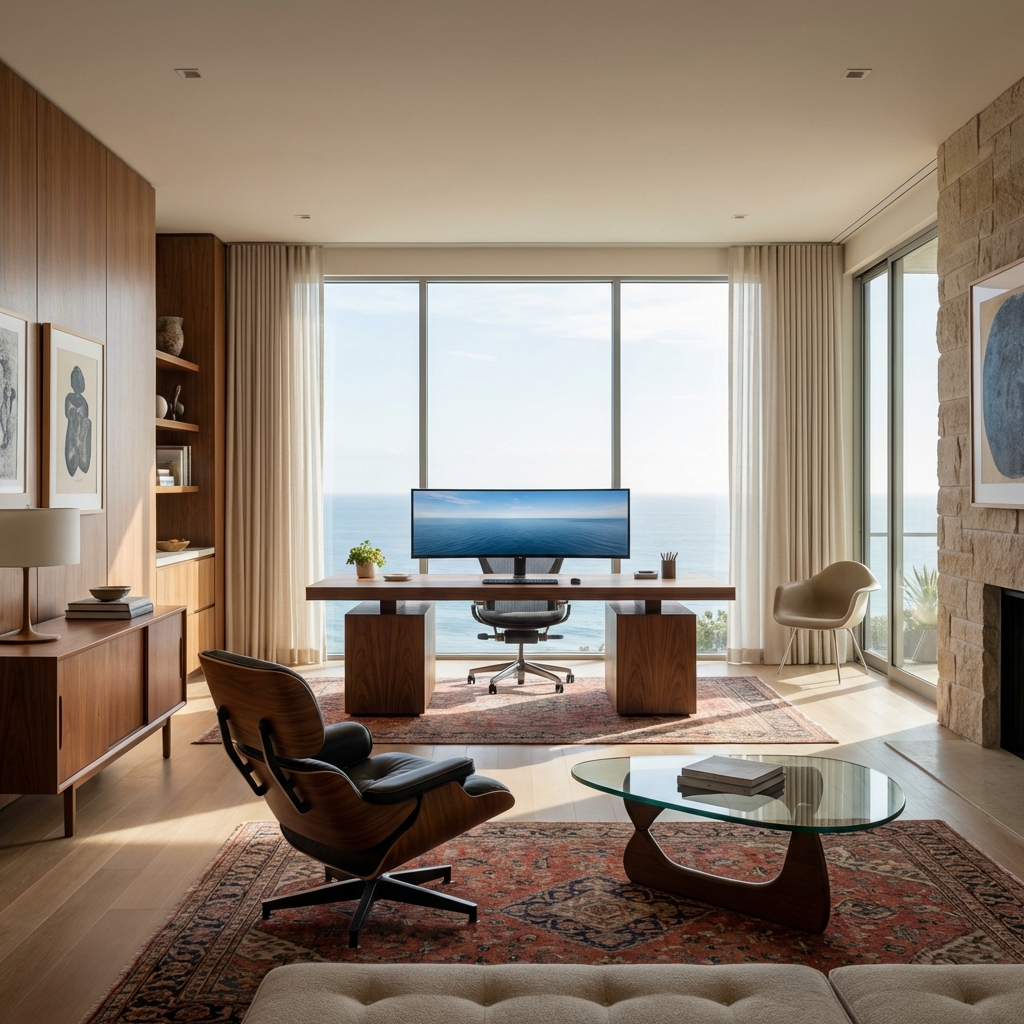
The Death of the TV Room: Why 2026 Apartments Need Massive Monitors
The 65-inch television is dead. It just doesn’t know it yet.
For decades, the "TV wall" has been the undisputed anchor of the living room—a black rectangular void demanding that all furniture point toward it in subservience. But in 2026, where the lines between high-end production and high-fidelity consumption have blurred, dedicating your prime vertical real estate to a passive legitimate screen is not just an aesthetic crime; it’s an economic failure.
In high-cost urban centers like New York, Singapore, and London, where price-per-square-foot hovers around the GDP of a small nation, the "TV Room" is an artifact of a bygone era. The future of the premium apartment isn't about consumption. It's about production.
The Economics of Square Footage: Passive vs. Active
Let’s look at the numbers. In a standard 700-square-foot one-bedroom apartment in a tier-one city, the living room accounts for roughly 40% of the floor plan. If 50% of that room is oriented solely around a television—a device used primarily for passive reception—you are effectively paying nearly a quarter of your rent for a "Netflix shrine."
That math doesn't work anymore.
The remote elite don't just watch content; they create it, trade it, and manage it. A passive living room setup is dead assets. By replacing the low-density utility of a TV wall with a high-density, multi-screen workstation, you flip the equation. That square footage now generates revenue. It transitions from a cost center to a profit center.
Dual-Use: The Rise of the Massive Monitor
The argument against the workstation used to be aesthetic: nobody wants an office in their living room. But hardware has evolved. We aren't talking about plastic Dells and messy cables anymore.
We are talking about the LG OLED Flex, the Samsung Odyssey Ark, and studio-grade displays that rival the best cinematic televisions in color accuracy and contrast.
A 55-inch curved 4K OLED monitor is a chameleon. From 9 AM to 6 PM, it is a mission control for day trading, coding, or video editing, capable of displaying four discrete 1080p windows simultaneously. At 7 PM, it reclines into entertainment mode, offering an immersive gaming or cinema experience that a wall-mounted TV across the room simply cannot match.
This is the convergence of "Lean Forward" (work) and "Lean Back" (entertainment). Why buy two screens when one superior glass sheet does both better?
The Privacy Premium: Why Coworking Failed the Deep Work Test
For a moment, the world thought WeWork was the answer. We were wrong.
Coworking spaces are excellent for networking, but they are hostile environments for deep work. The open floor plan is a productivity killer. Visual privacy is non-existent.
- 01.The Data Risk: In 2026, information is currency. You cannot review non-public financial data, proprietary code, or sensitive legal documents when a stranger is sipping oat milk latte over your shoulder.
- 02.The Zoom Fatigue: Taking a sales call in a "phone booth" that smells like the previous occupant's lunch is not a premium experience.
- 03.The Flow State Breaker: Constant movement, noise, and visual stimuli prevent the brain from entering deep flow.
A dedicated home station offers the ultimate luxury: control. Control over lighting, control over acoustics, and absolute control over who sees your screen. This is the Privacy Premium, and for high-net-worth remote workers, it is non-negotiable.
The 2026 Layout: Optimized for the Hybrid Athlete
So, what does the optimal 2026 apartment look like?
It’s an ecosystem. The bulky sofa facing the wall is gone, replaced by a modular lounge system that can be reconfigured. The TV wall is now a "Knowledge Wall"—a sleek, floating desk with a massive, arm-mounted OLED display, flanked by acoustic paneling and biophilic design elements.
For the Coder
Vertical monitors for documentation, ultrawide for the IDE.
For the Creator
A boom arm mic that swings out of nowhere, studio lighting integrated into the shelving.
For the Executive
A 4K webcam at eye level, ensuring you look like a leader, not a pixelated thumbnail.
This isn’t just interior design; it’s lifestyle engineering. By killing the TV room, we aren't losing a place to relax. We are gaining a command center for the digital age.
The revolution will not be televised. It will be streamed, coded, and created from a workstation that pays for itself.